
Whether it’s a care assessment, a hospital ward or a job interview, every system has the same choice: see the person, not the label, or start with the form.
If it wasn’t so serious, it would be quite funny.
Picture it. A social worker walks into a home they’ve never been in before. They don’t know the person they’ve come to see, and that person doesn’t know them. They sit down at the kitchen table with a form that’s miles long, because their boss needs it completed. An hour or so later they walk away with a page full of ticked boxes. Then they go and write a report.
And what do they actually know about that person? What they look like. That’s probably about as far as they’ve got.
I don’t blame social workers. I genuinely feel for them. What chance do they stand? In the time it takes to fill in a form, they’re expected to understand how someone ticks, how to speak to them, how to connect with them, and how to engage in a way that has any shout of being successful. No person can do that. It’s an impossible task, and we’ve built a whole system around it. It’s set up to fail.
 Fixing the symptoms never works
It’s like health, isn’t it? You can treat the symptoms all you like, but if the cause is still there, as big and bold as ever, nothing really changes. You end up forever firefighting. It costs more and more money, everyone knows deep down it isn’t going to work, and it’s a hiding to nothing.
The cause, as I see it, is this: the system meets the form before it meets the person.
Jen, as seen by “the panel”
Nowhere is this clearer than in something almost every parent in our world dreads: the panel.
Under the Care Act 2014, a local authority panel of social workers and health professionals reviews a person’s care assessment and decides what support they’re eligible for and how much funding they’ll get. Nobody is allowed to know who sits on it. In an age of freedom of information, that alone should give us pause.
Jen is represented to that panel by a social worker. It isn’t someone who has watched her dance, eaten with her, or seen what happens when the support isn’t there. It’s someone who might have met her once or twice. Jen’s life and ours, her needs and her humanity, are filtered through that brief acquaintance. Then they’re presented to a room of anonymous faces applying a framework that wasn’t designed for her.
The package is usually turned down. So you fight, you appeal, and you do it all again. Most parents are already exhausted and already feel unseen, and they give up after one or two rounds. The system doesn’t need to be designed to exhaust people. It only has to be hard enough that most people stop.
If you do win, it’s reassessed every year. Often that means someone’s “current presentation” is entered into a computer, which more often than not says fewer hours than before. Jen was born with Down syndrome. Her intellectual disability isn’t going to change. So why create another fight for families who are already fighting to survive?
Then there’s the judgement. One person, with one set of values, on one day, decides what counts as a need and what counts as a want. Dance was considered a want for Jen. The evidence didn’t say so. One person decided it.
Jen has since built her life around that “want”. She is now Dr (h.c.) Jen Blackwell BEM, co-founder of the award-winning charity DanceSyndrome. That’s why the question at the heart of Beyond Extraordinary: Who are you missing? matters so much: are you looking at an intellectual disability, or are you looking at somebody called Jen?
The cost of getting it wrong
The more connected you are to all of this, the more horrific it becomes, because the more you uncover, the more you know and the more you hear. Think of the sorrow, the pain and the anguish of the people who don’t find a way out. It’s catastrophic for their health and wellbeing, and for their relationships. It’s catastrophic for society too, because we lose everything those people could have given. It’s catastrophic all round.
And it isn’t only social care. The same thing happens on a hospital ward, in a job interview, in a school meeting or an annual appraisal: anywhere a system meets a human being through a form instead of a conversation.
Our glass was always half full
In our family, the glass always had to be half full, however empty it, and we, felt at the time. That’s because there always are solutions. They just aren’t always staring you in the face.
Solutions start with thinking differently and acting differently: being open to different possibilities and different conversations, and approaching people differently. They start with listening to people in a way that means they can actually be heard. It means seeing the person, not the label, and starting with a conversation, not a form. And it means giving the people doing this work the time and the freedom to know someone before we ask them to write a report about them.
Inclusion ticks boxes. Belonging changes lives. If we want a different result, we have to stop doing what we’ve always done.
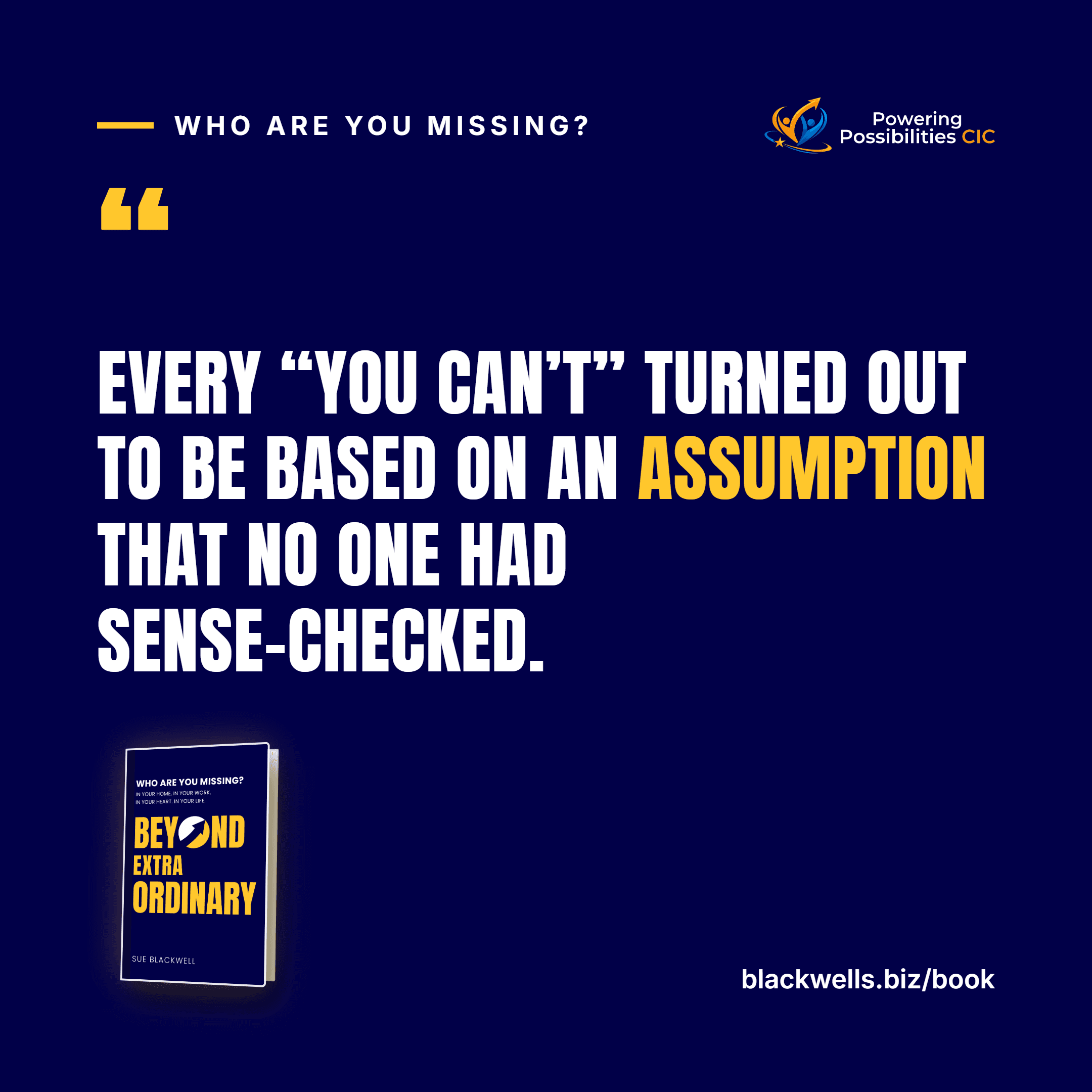
That’s what Beyond Extraordinary: Who Are You Missing? is about: the story of one family who refused to accept what the system decided was possible, and what happened when we did. It’s out at the end of November. Register to hear first at blackwells.biz/beyond-extraordinary-book.
______________________
Sue and Jen Blackwell are mother and daughter, co-founders of the award-winning charity DanceSyndrome, and the heart of a speaking partnership that includes husband and father Malcolm, whose 35-year career in international business leadership is one part of the family story. The Blackwells — Sue, Jen, Malcolm and son Anthony — have spent 45 years living what most people only theorise about, and built something remarkable in the process. They now lead Powering Possibilities CIC to help people and organisations stop waiting and start doing.