
Dear Jo Public
Is this the single largest inexcusable travesty of the 21st Century?
What do you know, or choose to know? Do you care?
I live in a world where injustices are metered out as commonplace where inequalities are the accepted norm, where people like my daughter Jen are unknown and unseen, invisible in full sight.
In my world people are routinely marginalised, denied their human rights, ‘othered’, frequently spoken about rather than with or to, referred to by their diagnosis. How often has my fevered imagination been forced to see an extra chromosome waltzing down the street rather than the daughter I know and love called Jen. Hearing Jen referred to yet again as ‘her’ or ‘she’ is an insult to Jen herself and to me, and all the more so when standing right there beside us.
Jo, it seems you have little or no comprehension of my realties. Why is there no public outcry when yet again another investigative journalist with another hidden camera highlights the horrors of the lives of people routinely abused in institutionalised care? Do you know, do you not care or do you choose to ignore?
This is one example of the extreme horror families find themselves facing. Just imagine. It could easily have been your family. Your loved one may have been removed from your home and be held ‘securely’ restrained in a paddded room hundreds of miles away. How would you cope?
There are numerous other situations such as the tragic figure of 40.2% of deaths being avoidable had medics been atuned or attentive to the wellbeing and needs of people in their care, and then there are the thousands of families caught in the snares of education, health, and/or social care who must struggle to be heard to have basic human rights upheld, all of which you, Jo Public, has handed to you on a plate.
I have recently had the good fortune to trip across two powerful and absorbing books, both embracing living in parallel universes ; Songlight by Moira Buffini, and When the Cranes Fly South by Lisa Ridzen. And to have attended the captivating Angus Millar Lecture hosted by the RSA and given by Jo Salter MBE highlighting the need of all humans to be part of the whole of humanity.
Songlight acknowledges that we are all different, but some of our differences can seem threatening to others who prefer us all to conform. Weak leadership wants to keep us all in place, whereas strong leadership encourages each of us to explore and develop our unique personalities. In Songlight those with the special powers can converse with each other across the miles, but if discovered they will potentially pay with their lives or with constraints in the form of lead head bands and physical intervention denying further conversation. Some become servants to the leaders and are only allowed to use their skill for the purpose of their masters resulting in their unique character waning, a very few become adept at avoiding discovery and developing their skills.
Inclusion of itself is not enough
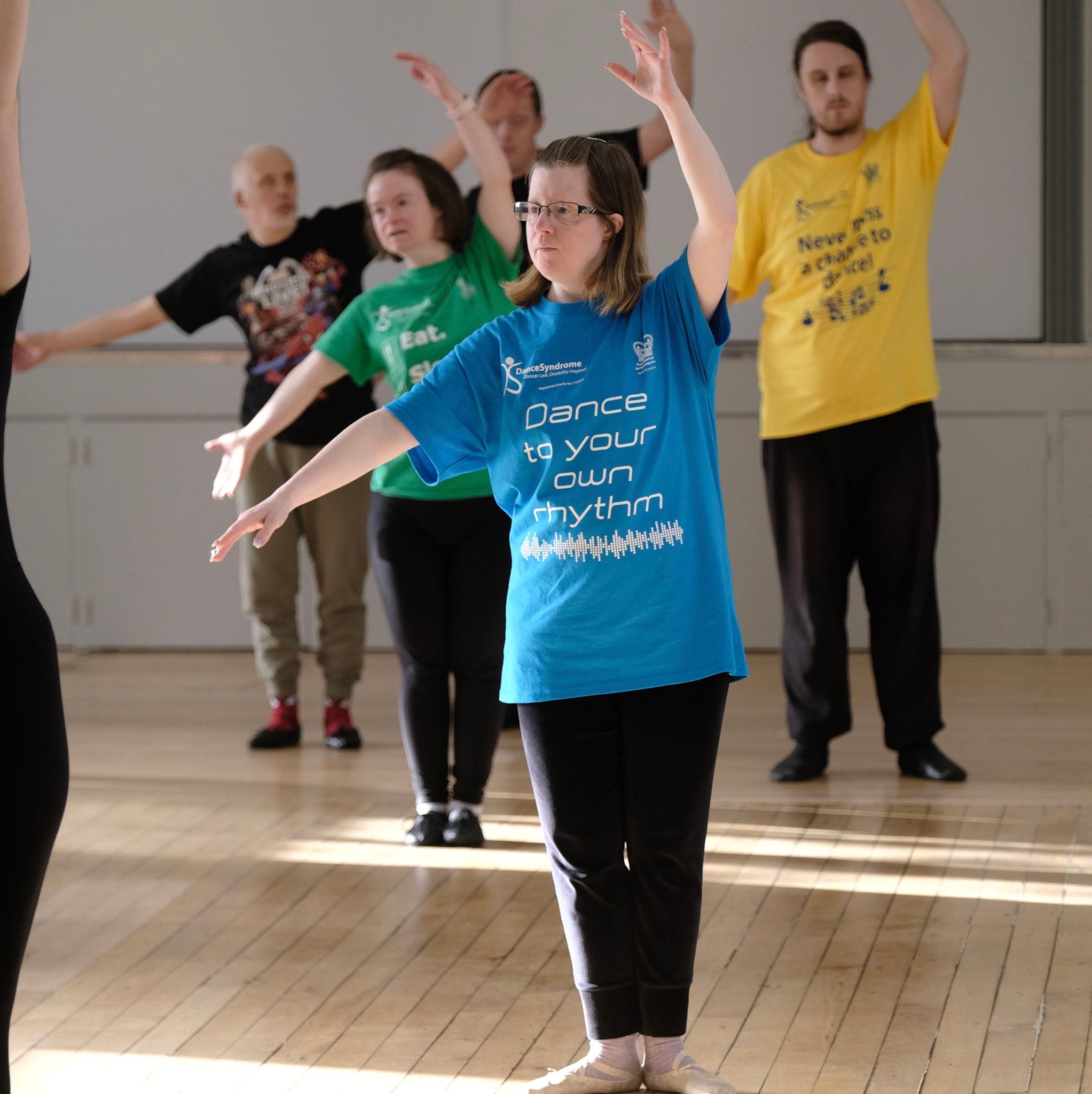
Jen with other dancers at DanceSyndrome session
This resonates so powerfully with me, accustomed as I am to witnessing the incredible resilience, creativity and resourcefulness of the Dance Leaders at DanceSyndrome, all of whom have learning disabilities, all of whom experience being heard, being valued, being embraced and respected as their unique selves, all of whom love being in demand, being included. But inclusion of itself is not enough. It needs equity to underpin inclusion for you to belong. When you belong the support that you need is not an add on, it is an integral part of that community and your life and you have the opportunity to develop your sense of self. This is when the magic happens and leaders from unexpected places emerge. It allows those people previously unnoticed or invisible to hold their heads up high. For me, this is imperative if you are to be a contributing member of society, and to be able to fully connect with humanity.
Both my parents have recently passed away making When the Cranes Fly South especially powerful and meaningful helping me to understand more of their final years. How much do we actually know about what goes on in a person’s mind as their body fails through old age or illness or dementia? At what point do you cease to be able to control your life as you’ve previously been accustomed to? Do you relinquish control graciously or kicking and screaming? Are you consciously aware that you are no longer the person you were? Or that others around you may have changed out of all recognition? Do you cling to the past? Or in the case of Bo, inhabit the present in failing body with the aid of crutches in the form of Hans, Ture, Ingrid, Sixten, a bumblebee and a scarf, whilst your mind often dwells in other memorable places and spaces with those you love and have loved. The hardest thing of all has to be to realise, if indeed you can, that the others around you still love you, are seeking to protect you and make the best of decisions on your behalf even when they are at odds with your mindset. I am immensely saddened to now recognise that my father with whom I didn’t have a close relationship, seemingly never unlocked that sense of self, that connection to himself throughout his life. Hence there was no one, and nothing to provide that all important crutch when he most needed it. Might this explain why he could never accept and connect with Jen? Is this true for innumerable others too?
What gives us the right to make assumptions?
We, the 98% of society without learning disabilities determine what should happen to that other 2%. What gives us the right to make assumptions? What medic has the right to tell you with your daughter aged 5 months what her life will look like or what she will achieve? How can they know? How can anyone know whether any person of 5 months old is the next bus driver, prime minister, mayor or Einstein? Is any one job more important than any other? A factory cannot operate without people manufacturing product internally, others driving sales and strategy. All are part of the whole and as such all of necessity are valued and respected. All need appropriate support in order to maximise their contribution to the whole.
The same is true for people with learning disabilities. When we listen astutely to their needs, provide them
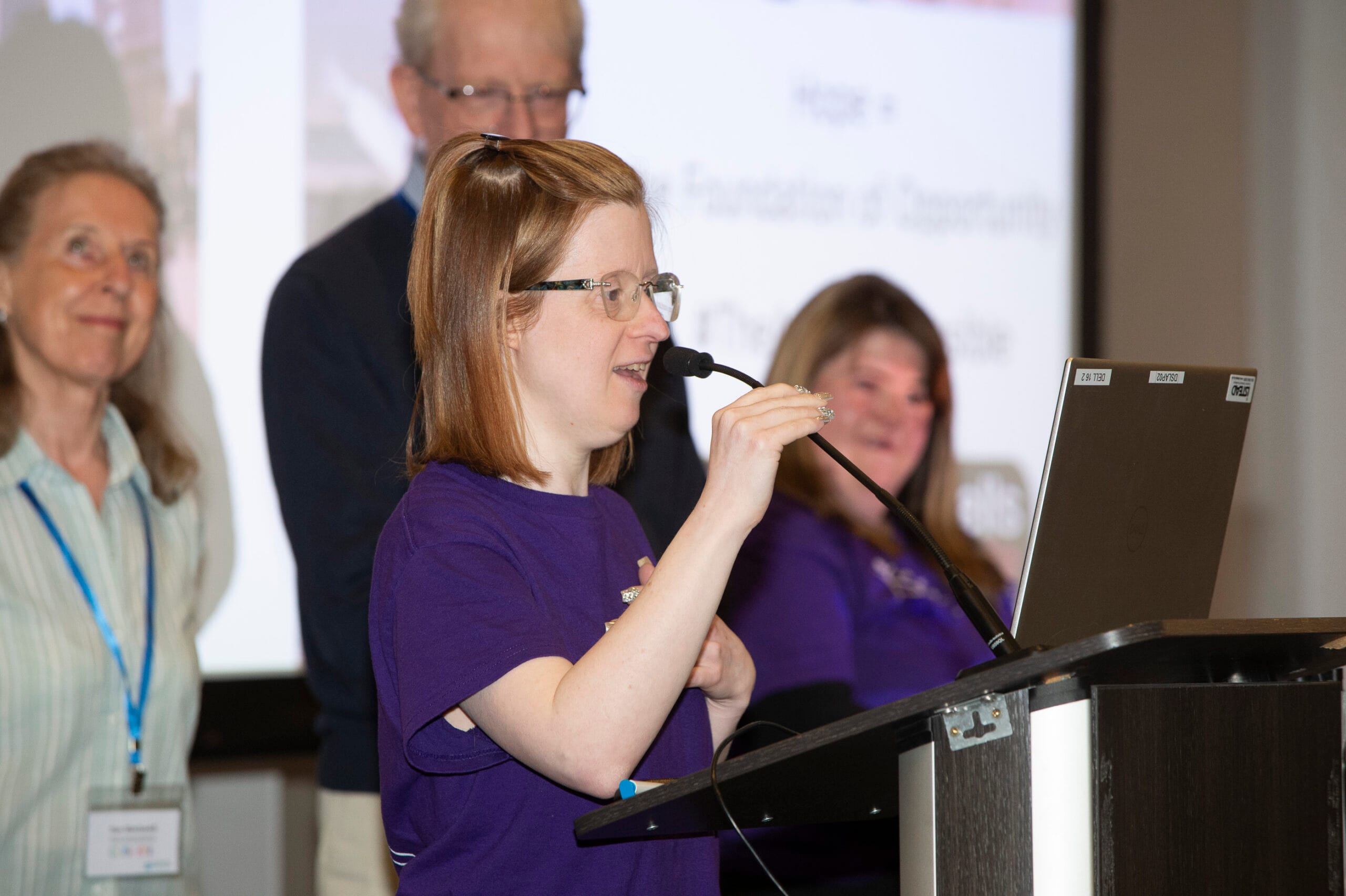
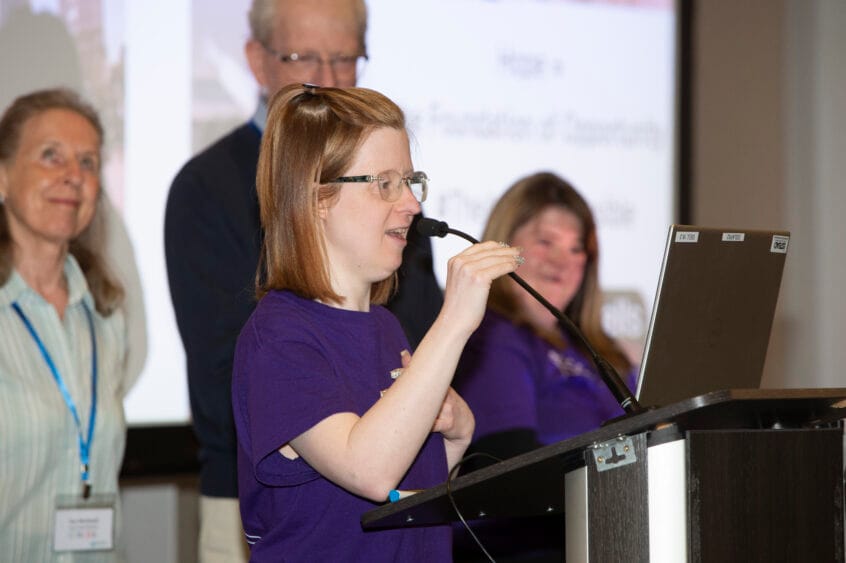
Jen leading the keynote talk at ClubHub conference May 2025 supported by Sue, Malcolm and dance leader Lucy Burgess
with the support they need at the time they need it, recognise that every area of their lives needs to be functioning smoothly, are open to innovative creative unusual suggestions and solutions, incredible unexpected things can happen. I cannot help but be reminded of this every time Jen is invited to speak at her next prestigious event, to receive yet another accolade or attend an awards ceremony as a VIP. Or as happened last week, to proudly pick up her next Krav belt. None of this was foreseen or planned. But all of this is happening as we travel forward on our extraordinary voyage through life.
Next stop for Jen? Representing Blackwells at ClubHub in May, VIP awards event at Royal College of Nursing Foundation Impact Awards in June. Jen’s aspirations remain focused – to travel the world with her dance and deliver more events like Encounter 360 in Florida where she was a keynote speaker.
Next stop for me? A flying visit to the UK then provisioning for 18 days and sailing back across the Atlantic the week after!
We are on a crusade for social change. We know what’s possible when we put equity, inclusion and respect at the heart of everything. Jo, we need you to wake up choose to see what’s really going on in front of our eyes and join the voices crying out for change.
Sue Blackwell – Mum of Jen and Anthony, co-founder & Director of DanceSyndrome and Blackwells.biz
______________
Some of the stories & people to learn more from about the inequalities those families with learning disabilities face every day:
Journalist John Harris, https://www.theguardian.com/commentisfree/2025/jul/20/learning-disabled-people-book-winterbourne-view
Journalist Saba Salman
2 Comments on “Is this the single largest inexcusable travesty of the 21st Century?”
Sue, your perspective hits home because it exposes the quiet catastrophe of systemic indifference we’ve allowed to persist for far too long. It’s absolutely infuriating how easily our culture renders vibrant individuals invisible, yet the fierce resilience of leaders like Jen proves that true belonging requires more than just passive inclusion; it demands the dismantling of these rigid barriers to finally reclaim our shared humanity. We have to stop accepting this status quo where the most vulnerable are treated as afterthoughts, and instead, actively cultivate environments where every voice is heard, valued, and fundamentally respected as an integral thread in the larger social fabric.
Dennis. I love the idea of being integral threads in the larger social fabric. Passive inclusion doesn’t cut it. I see true belonging as a default setting of necessity. Either it’s how you function or it isn’t. It makes us all equal on all fronts whether deciding what to have for dinner, preparing it, eating it, or clearing up afterwards. Every person has an equal part to play. No person is excused from contributing, no person is expected to contribute in unrealistic impractical ways, but all can contribute to achieving the end result. I can’t deny it takes more time and patience, but the increased sense of achievement for all concerned makes this a small price to pay in my books.
Society in general appears to have little or no concept of the injustices metered out to marginalised minorities. I continue to be bemused that people sit on their hands, watching. Where is their metal? Where is their outrage? Where are their values?
We can all start with the easy wins, and the bigger wins will follow as confidence and that sense of self empowers people to walk tall holding their heads up high becoming more visible and connected within their communities whether geographical, issue based, or virtual.